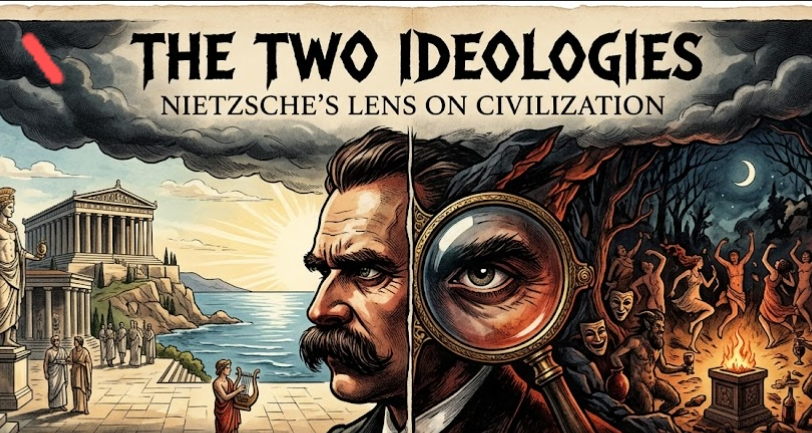
The Two Ideologies: Nietzsche's Lens on Civilization
HinduText AI से इस लेख का सारांश समझें
लेख के मुख्य आध्यात्मिक संदेश एवं सारांश पर AI से चर्चा करें
There are, at their core, only two ideologies in the world — two great opposing forces that have shaped the entire arc of human civilization: &n...
There are, at their core, only two ideologies in the world two great opposing forces that have shaped the entire arc of human civilization
1. The Aryan Form
2. The Doctrine of Equality
The Aryan Form is the ideology of hierarchy, creative will, and civilizational order. One can observe its manifestations across the ancient world — in Egypt, in Rome, in Greece, and most elaborately and durably, in India. These were not mere political arrangements but entire cosmological visions translated into living social structures. The Aryan Form built— it raised temples, codified law, cultivated philosophy, and forged civilizations from raw earth and raw will.
The Doctrine of Equality, by contrast, is perhaps the most destructive idea in the history of the human race. It did not emerge from strength — it emerged from resentment. It was Christianity that first injected this poison into the Western bloodstream, giving the weak a theology of revenge dressed in the language of virtue. What it called "salvation," Nietzsche recognized as systematic enfeeblement.
As Nietzsche wrote in Twilight of the Idols:
In physiological terms: in a fight with an animal, the only way of making it weak may be to make it sick. The Church understood this: it ruined man, it made him weak — but it laid claim to having 'improved' him.
The slave did not wish to overcome the master. He wished to pull the master down — to abolish the very distinction between high and low, noble and base, creator and parasite. This is the essence of the egalitarian revolt. It is not a cry for justice. It is a cry of envy wearing justice as a mask.
Nietzsche saw through this mask with surgical clarity. In The Antichrist (§57), he writes:
Wrong never lies in unequal rights; it lies in the assertion of 'equal' rights... What is bad? But I have already answered: all that proceeds from weakness, from envy, from revenge. The anarchist and the Christian have the same ancestry.
Here Nietzsche identifies what most political thinkers refuse to admit: the anarchist and the Christian are not opposites — they are cousins. Both are animated by the same subterranean rage against natural hierarchy. The revolutionary who tears down thrones and the priest who preaches that the meek shall inherit the earth are working toward the same end by different means.The Aryan Form understood something the egalitarian mind cannot grasp — that civilization is not built by erasing distinctions but by ordering them. Nietzsche himself acknowledged the supreme example of this in the Laws of Manu, which he regarded with undisguised admiration in Twilight of the Idols:
Now let us consider the other case, which is called morality, the case of the rearing of a particular race and species. The most magnificent example of this is offered by Indian morality, and is sanctioned religiously as the 'Law of Manu.' In this book the task is set of rearing no less than four races at once.
This is the Aryan Form in its most philosophically conscious expression — not a brutal domination, but a disciplined architecture of human types, each fulfilling its function within a greater organic whole.
The great European civilization was not destroyed by superior enemies from without. It was hollowed out from within — by a doctrine that told every man he was the equal of every other, that hierarchy was injustice, that the strong owed an infinite debt to the weak. What Christianity began, secular liberalism completed. The anarchist simply picked up where the priest left off. Nietzsche's entire philosophical project can be read as the attempt to diagnose this illness and point, however obliquely, toward its cure — a return to the affirmative, life-ordering, hierarchy-embracing spirit of the Aryan Form.

Saptarshi Pahari
280M.Sc. Physics student focused on Electronics | Independent researcher in structural philosophy & traditional history | Essayist & author of The Anatomy of Social Friction. Saptarshi Pahari is a traditionalist writer and analyst dedicated to the defense of orthodox Hindu theology



Comments & Discussion 3