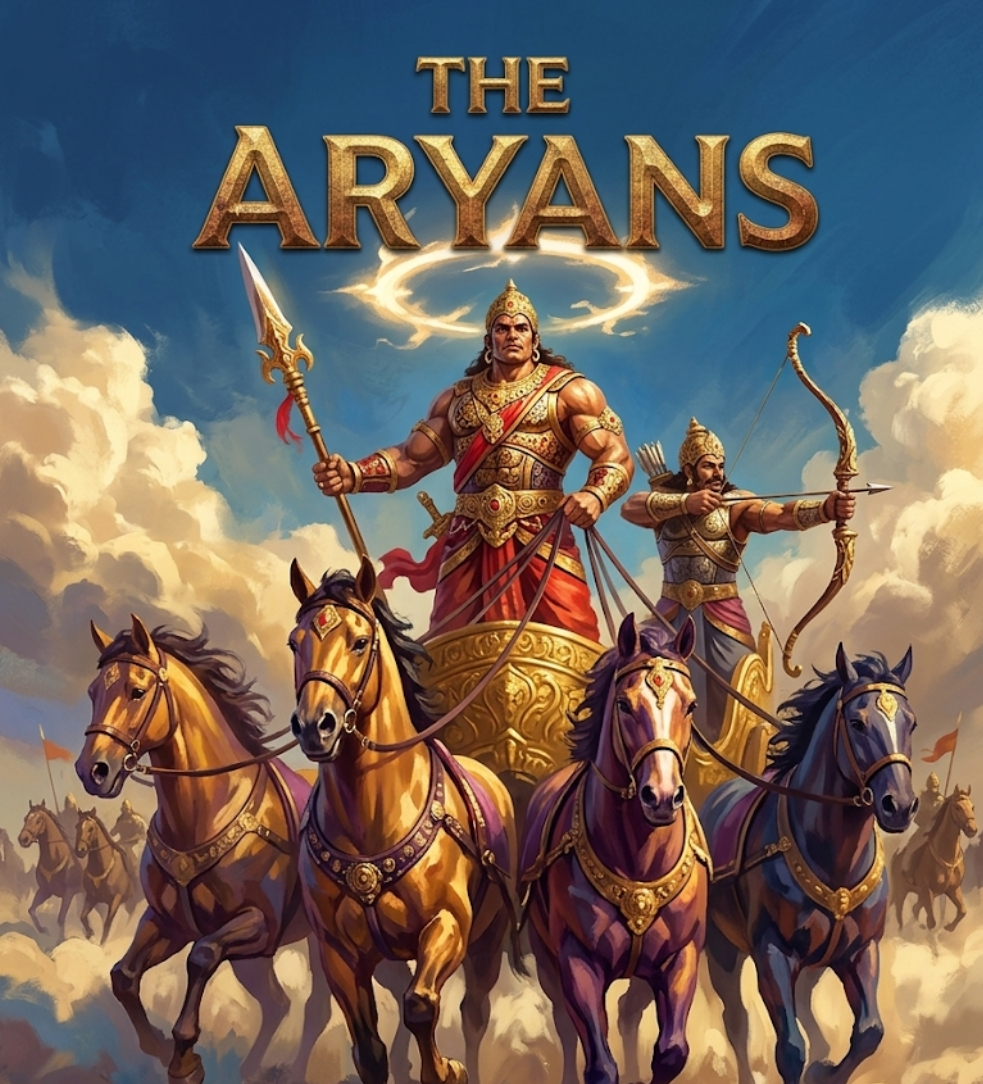
Who Are the Āryas?
HinduText AI से इस लेख का सारांश समझें
लेख के मुख्य आध्यात्मिक संदेश एवं सारांश पर AI से चर्चा करें
They tried to snatch the Arya identity. They told you it was just a language group, that anyone could convert into it. They claimed they're also...
They tried to snatch the Arya identity. They told you it was just a language group, that anyone could convert into it.
They claimed they're also from the great Aryan race.
But which Aryans were they who ran from open battle and stabbed their enemies from behind? Which Aryans were they who never worshipped the Sun, never maintained the sacred fires, and never lived by the cosmic order?
They forgot one simple thing: the traditional Aryans never left. The texts are still here. The lineage is still here.
Enough with the secular apologies. Read exactly who the Arya are?
I. The Problem of Definition:
There is a simple philosophical principle that moderns conveniently forget when it serves them: the one who coins a term owns its definition. You cannot call iron an apple and then lecture botanists about apple composition. The category belongs to its originator. The definitional authority is non-transferable.
"Aryan" — Ārya — is a term coined, used, and systematically defined by ancient Hindus. Not by European philologists. Not by Nazi ideologues. Not by 19th-century British colonial linguists with a civilizational agenda. The Hindus. Which means if you want to know what Aryan means, you go to the source. You go to the texts that first deployed the term with deliberate philosophical precision.
And when you do, the answer is unambiguous.
II. The Authoritative Source
The primary law-text of the Aryans is the Manusmṛti. This is not an arbitrary claim — it is established by the Shṛuti tradition itself. The saying runs: "Whatever Manu says is medicine." (Taittiriya Samhita (2.2.10.2))
Manu is not one opinion among many. Manu is the definitional authority on dharmic social order.
So we ask Manu: Who is an Ārya?
Manu answers in Chapter 10. Let us read him carefully and without the fog of secular anxiety.
III. Manu 10.45 — The Verse That Ends The Debate
मुखबाहूरुपद्जानां या लोके जातयो बहिः ।
म्लेच्छवाचश्चार्यवाचः सर्वे ते दस्यवः स्मृताः ॥
mukhabāhūrupadjānāṃ yā loke jātayo bahiḥ |
mlecchavācaścāryavācaḥ sarve te dasyavaḥ smṛtāḥ ||
Translation: "Those jātis in the world that are born outside the mouth-arm-thigh-foot — whether they speak Mleccha language or Ārya language — all of them are called Dasyus."
Read this with full attention. Manu constructs a two-variable test: varṇa membership AND language. Then he rules that language is irrelevant. A person speaking the Ārya language (āryavācaḥ) but standing outside the four-varṇa order is still a Dasyu — still a non-Aryan.
This single verse pre-emptively destroys the entire modern "Aryan as linguistic group" thesis — written by Manu himself, in the very text that defines Ārya identity.
Note the irony the moderns cannot escape: the first text to use the term Ārya language (āryavāc) uses it specifically to demonstrate that language does not define who an Āryan is. Manu invented the linguistic category and immediately subordinated it to the biological-civilizational one.
The four varṇas — born of the mouth, arms, thighs, and feet of Puruṣa — are the boundary condition. Inside that boundary: Ārya. Outside it, regardless of what language you speak: Dasyu.
IV. Manu 10.69 & 10.71 — Birth Is The Only Gate
Manu 10.69:
"As good seed springing up in good soil turns out perfectly well, even so the son of an Aryan by an Aryan woman is worthy of all the sacraments."
Manu 10.71:
"Seed, sown on barren ground, perishes in it; a fertile field also, in which no good seed is sown, will remain barren."
Manu's framework is precise. Seed is the man — the paternal civilizational carrier. Field is the woman — the receptive condition. Ārya identity is transmitted through birth from Ārya parents. 10.69 states this positively: the right seed in the right field produces a son worthy of all sacraments. 10.71 states it negatively: neither element alone is sufficient — but the seed is the active principle, the field is the condition.
The implication is total and leaves no room for modernist reinterpretation. You cannot adopt Ārya identity. You cannot convert into it. You cannot speak your way into it, behave your way into it, or believe your way into it. No cultural assimilation qualifies. No religious initiation transfers it. No linguistic fluency confers it.
The gate is birth. Only birth.
V.Manu 10.73 — Behavior Cannot Convert Identity
"Having considered the case of a non-Aryan who acts like an Aryan, and that of an Aryan who acts like a non-Aryan, the creator declared: 'Those two are neither equal nor unequal.'"
This verse is philosophically precise in a way that deserves careful unpacking.
"Neither equal nor unequal" is not vague. It is a statement about ontological categories. The non-Aryan who performs Aryan behavior has not become an Aryan. The Aryan who degrades himself has not become a non-Aryan. The categories do not convert into each other through behavior. They remain distinct — incommensurable — because their basis is birth, not conduct.
This is the creator's own declaration in Manu's text. Behavior is something Aryans should exhibit — Manu elsewhere elaborates Ārya qualities and war-morality at length — but behavior is the obligation of the Aryan, not the definition of one. The qualities describe what the category demands of itself. They do not constitute the category.
The modern conflation of descriptive qualities with definitional criteria is precisely the error Manu corrects here.
VI. The Ramayana Corroboration:
One might object: is this purely a Manusmṛti position, or does it hold across the broader tradition?
Valmiki Ramayana 6.110.4:
Āaryaputreti vādinyo hā nātheti ca sarvaśaḥ | paripetuḥ kabandhaāṅkāṃ mahīṃ śoṇitakardamām ||
Women crying "Āryaputra!" — "Son of an Aryan!" — lamenting over headless trunks on a blood-soaked earth. This is the fall of Laṅkā. These women are mourning Rāvaṇa's warriors. And they call them Āryaputras.
This is decisive for multiple reasons simultaneously:
Laṅkā had a functioning varṇa order. The term Ārya applied to Laṅkā's population. Which means Ārya identity was never a North Indian ethnic marker, never a geographic designation, never a racial category in the European blood-and-soil sense. It was a civilizational-varṇic identity that could exist in Laṅkā as readily as in Āryāvarta.
The canonical enemy of Rāma is called Āryaputra by his own people. If the term had any geographic, ethnic, or linguistic exclusivity, this usage would be impossible.
VIII. What "Aryan" Is
Ārya is a birth identity within the varṇa order.
The four varṇas — Brahmin, Kṣatriya, Vaiśya, Śūdra — born of the cosmic Puruṣa, transmitted through seed, bounded by the laws Manu codifies — this is the Ārya order. Those born within it are Āryas. Those outside it are not, regardless of language, geography, or behavior.
As established in the previous essay (In the Defense of Traditional Hindu Theology), varṇa itself is by birth. The present essay simply extends that foundation: if varṇa is by birth, and Ārya identity is defined by varṇa membership, then Ārya identity is by birth. The syllogism closes cleanly.
The definition was never lost. It was always in the text. The moderns simply chose not to read it — or chose to read around it, because the text says something they find inconvenient.
Manu did not leave ambiguity. The ambiguity is entirely a modern production.
Even Nietzsche — hostile witness, philosophical adversary of the priestly order — when he reads Manu directly, calls the system by its correct name. "Specifically Aryan forms." Not a language group. Not a steppe migration. The cold-blooded, reflective, world-influencing civilizational order of the varṇa system.
“We possess the classic model in specifically Aryan forms: we may therefore hold the best-endowed and most reflective species of man responsible for the most fundamental lie that has ever been told-- That lie has been copied almost everywhere: Aryan influence has corrupted all the world”
—Will To Power
Saptarshi Pahari
280M.Sc. Physics student focused on Electronics | Independent researcher in structural philosophy & traditional history | Essayist & author of The Anatomy of Social Friction. Saptarshi Pahari is a traditionalist writer and analyst dedicated to the defense of orthodox Hindu theology

Comments & Discussion 12