Revisiting the Indica of Megasthenes
Hinduism is the oldest religion of the Asian subcontinent — a fact accepted by academics around the world. Though in recent years online discour...
Hinduism is the oldest religion of the Asian subcontinent — a fact accepted by academics around the world. Though in recent years online discourses have seen a rise of revisionist history challenging academia, some of these revisionist views are genuinely thought-provoking while others fall well below scholarly standards. Today we will address two such claims — one circulating in left-liberal circles and one in Ambedkarite circles.
Left-liberal circles, though they are the pioneers of the "5,000 years of oppression" narrative, have recently begun claiming that caste endogamy only became strict after 100 CE and not before. They draw a major distinction between what they call "Brahminism" of the pre-Ashokan era and modern Hinduism.
Ambedkarite circles have taken this further, claiming there was no Hinduism in the pre-Ashokan era at all — that Hinduism later copied everything from Mahayana Buddhism, that Megasthenes makes no mention of Hinduism, and that the "Brachmanes" Megasthenes mentions were actually a Buddhist sect.
Before establishing the facts, it must be noted that academia accepts the Vedas as dating to approximately 1500 BC, based on inscriptions such as the Bogazköy inscription from Anatolia, where names of major Vedic deities including Indra, Mitra, Varuna, and Nasatyas appear in a treaty between the Hittites and Mitanni — firmly placing the Vedic tradition in the pre-Buddhist world.
With that established, let us turn to our primary evidence. Rather than beginning with Hindu or Buddhist scriptures, let us first examine a contemporary external source — the Indica of Megasthenes. Though the original text is lost, his work is extensively quoted by later writers including Diodorus Siculus (c. 80 BC), Strabo (c. 64 BC–24 AD), and Arrian (c. 86–160 CE). Through these citations, we obtain a remarkably detailed picture of Indian society around 300 BC — well before the Gupta period that revisionists treat as the birth of Hinduism.
The Social System — Endogamy and Hereditary Occupation:
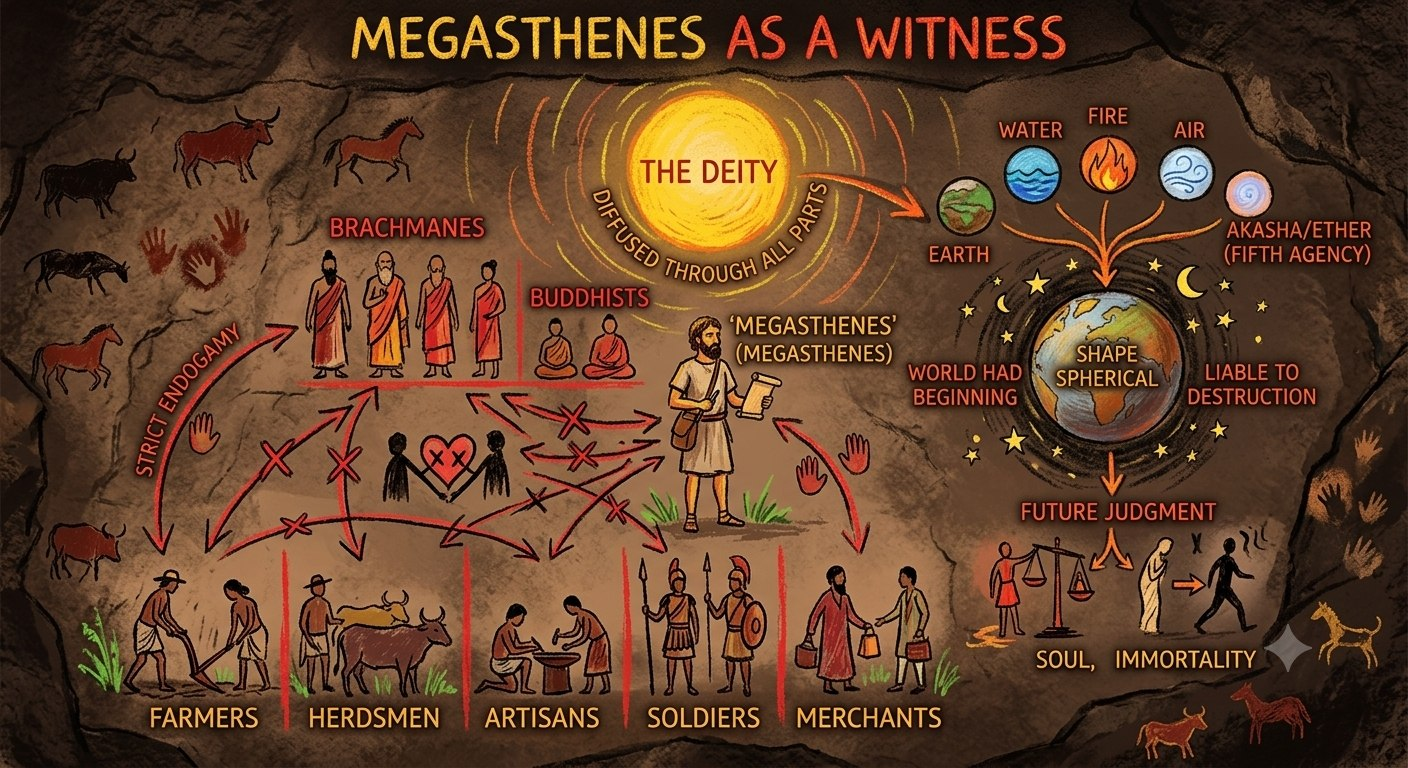
Both Diodorus and Arrian record that India had seven social divisions. At this point, Ambedkarites argue that these were not the rigid Brahminical Varṇa divisions but simply a functional division of labour as exists in all societies — pointing out that the number seven exceeds the four Varṇas of Manusmriti (which also enumerates numerous Jātis with specific occupations). However, the problem for this argument does not begin with the number. It begins when Diodorus directly quotes Megasthenes:¹
"Τα μέν ούυ μέρη τής διηρημένης πολιτείας παρ' Ἰνδοῖς σχεδόν ταῦτ' ἐστιν· οὐκ ἔξεστι δὲ γαμεῖν ἐς ἄλλου γένους ἢ προαιρέσεις ἢ τέχνας μεταχειρίζεσθαι, οἷον στρατιώτην ὄντα γεωργεῖν ἢ τεχνίτην ὄντα φιλοσοφεῖν."
"It is not permitted for anyone to marry into another caste, or to change from one profession or trade to another; for example, a soldier cannot become a farmer, nor can an artisan become a philosopher."
The conclusion is clear — this was a rigid, hereditary system, not a mere functional division of labour. We learn from this single passage that both endogamy and occupational rigidity were firmly established in India well before the Mauryan era.
Arrian corroborates this:²
> "The custom of the country prohibits inter-marriage between the castes — for instance, the husbandman cannot take a wife from the artisan caste, nor the artisan a wife from the husbandman caste. Custom also prohibits anyone from exercising two trades, or from changing from one caste to another. One cannot, for instance, become a husbandman if he is a herdsman, or become a herdsman if he is an artisan."
This is nothing but Manusmriti in practice. Manusmriti 3.14 states that a twice-born man must marry within his own Varṇa, and that taking a wife from a lower Varṇa degrades the family line. Manusmriti 10.97 states that a man obtains prosperity by faithfully discharging the duty assigned to his own caste and that there is no higher duty than one's own svadharma.
Diodorus did not invent or exaggerate. What he recorded is a precise, externally observed summary of the Varṇa system as Manusmriti codifies it — hereditary occupation, endogamous marriage, royal enforcement, and the absolute prohibition of crossing Varṇa boundaries in either profession or intellectual life. The match between his Greek description and the Sanskrit text is so close that Manusmriti Chapters 1, 3, 8, 9, and 10 together serve as the legal and cosmological source document for everything Diodorus and Arrian report. Since this tradition continues to be practised by Hindus on a large scale to this day, the claim by Ambedkarites and modern leftists that Hinduism did not exist before the Gupta era is refuted by Megasthenes' Indica alone.
A revisionist may object — if this were truly the rigid four-Varṇa Brahminical system, why does Megasthenes record seven divisions and not four?
Manusmriti never claims only four occupational groups exist on the ground. It establishes four Varṇas as the cosmic-theological framework and enumerates dozens of Jātis beneath them — Chapter 10 alone lists scores with specific hereditary occupations. The four-Varṇa structure is the metaphysical skeleton. Jātis are the living flesh upon it.
Megasthenes was not a theologian reading Sanskrit scripture. He was a Greek ambassador making ground-level observations — recording the seven most visible occupational groups functioning in Mauryan society. Manusmriti gives architecture. Megasthenes describes the city as it actually appeared to a foreign visitor.
The two accounts are not contradictory — they describe the same reality from different vantage points.
Crucially, both agree on the one thing revisionists deny — the system was rigid, hereditary, and endogamous. Whether you count four divisions or seven, Diodorus and Arrian are unambiguous that no one could marry outside their group or change their occupation. That rigidity is the Brahminical Varṇa-Jāti system in practice, whatever number a Greek observer chose to count.
The Philosophy of the Brachmanes — Strabo's Account
Having established the social system, let us now turn to philosophy. Strabo (XV.1.58–60) records Megasthenes' description of the Brachmanes' worldview:³
> "Their ideas about physical phenomena, the same author tells us, are very crude, for they are better in their actions than in their reasonings, inasmuch as their belief is in great measure based upon fables; yet on many points their opinions coincide with those of the Greeks, for like them they say that the world had a beginning, and is liable to destruction, and is in shape spherical, and that the Deity who made it, and who governs it, is diffused through all its parts. They hold that various first principles operate in the universe, and that water was the principle employed in the making of the world. In addition to the four elements there is a fifth agency, from which the heaven and the stars were produced. The earth is placed in the centre of the universe. Concerning generation, and the nature of the soul, and many other subjects, they express views like those maintained by the Greeks. They wrap up their doctrines about immortality and future judgment, and kindred topics, in allegories, after the manner of Plato. Such are his statements regarding the Brachmanes."
A careful reading of this passage reveals that it is nothing less than a condensed summary of Manusmriti Chapter 1. Let us examine the correspondences one by one.
On creation and cyclical destruction — The concept of the universe having a beginning and being liable to destruction is entirely Vedic. It stands in direct contrast to Buddhist philosophy, which generally rejects a creator God and a definitive cosmological origin. Manusmriti 1.57 states: "Thus by waking and sleeping, the Imperishable One incessantly brings to life and destroys all that is moveable and immoveable." The same teaching appears in Viṣṇu Purāṇa Chapter 1: "May that Viṣṇu, who is the existent, imperishable Brahma, who is Īśvara, who is spirit — who with the three qualities is the cause of creation, preservation, and destruction..."
Unlike Buddhist philosophy which treats cosmogonic questions as unanswerable (avyākata) and rejects a creator deity entirely, the Brachmanes of Megasthenes describes a fully formed creationist cosmology — identifying them unambiguously with the Brahminical tradition.
On the Deity diffused through all parts — Megasthenes' phrase "the Deity who made it, and who governs it, is diffused through all its parts" is a precise echo of Manusmriti 1.7: "He who is beyond the grasp of the senses, subtle, unmanifest, and eternal; who pervades all beings and is inconceivable — He alone manifested Himself." The exact Sanskrit term employed in Manusmriti here is sarvabhūtamayaḥ— meaning "He who is present in all beings." The same parallel appears in Viṣṇu Purāṇa Chapter 2: "Having glorified him who is the support of all things; who is the smallest of the small; who is in all created things; the unchanged, imperishable Puruṣottama."
On the fifth agency from which heaven and stars were produced — This refers unambiguously to Ākāśa (ether/space), the fifth mahābhūta (great element) of Brahminical cosmology. Manusmriti 1.20 and 1.75 place Ākāśa beyond the four gross elements — earth, water, fire, and air — as the subtlest element from which the luminous heavenly realm emerges. The Manu Smriti 1.75-78 states the sequence explicitly: "From the Ātman, Ākāśa was born; from Ākāśa, Vāyu; from Vāyu, Agni..." — placing Ākāśa as the first and highest element to emerge from pure consciousness. Viṣṇu Purāṇa Chapter 2 confirms: "Then, ether, air, light, water, and earth, severally united with the properties of sound and the rest, existed as distinguishable according to their qualities." It is worth noting that the Greeks later adopted a structurally similar concept through Aristotle's aether— the incorruptible fifth element of the heavens — almost certainly influenced by cultural contact with the East. The concept, however, is native to and far more elaborately developed within Brahminical cosmology.
Conclusion
The revisionist claim that Vedic religion was not practised before the Gupta period, or that the Brachmanes of Megasthenes were Buddhist rather than Brahminical, collapses entirely under the weight of the Greek sources themselves. Megasthenes was writing around 300 BC — centuries before the Gupta era and contemporary with the early spread of Mahayana Buddhism. What he describes — endogamous marriage restricted by caste, hereditary and immovable occupational duty, a creator God pervading all creation, cyclical cosmology, the five elements with Ākāśa at their summit, the soul, immortality, and future judgment wrapped in allegory — is the unmistakable philosophical and social fingerprint of the Brahminical tradition as codified in the Manusmriti and the early Purāṇas.
The Indica of Megasthenes, read in full rather than in convenient snippets, does not leave room for revisionism. It is a contemporary external witness to a living, structured, philosophically sophisticated Hindu civilisation flourishing three centuries before the Common Era. Revisionists of all persuasions would do well to read the complete source before drawing their conclusions.
---
*¹ Diodorus Siculus, Bibliotheca Historica, II.40–41
*² Arrian, Indica, XI–XII
*³ Strabo, Geographica, XV.1.58–60

Saptarshi Pahari
280M.Sc. Physics student focused on Electronics | Independent researcher in structural philosophy & traditional history | Essayist & author of The Anatomy of Social Friction. Saptarshi Pahari is a traditionalist writer and analyst dedicated to the defense of orthodox Hindu theology

Comments & Discussion 1