The Peacock’s Prayer: Solar Worship and Protection in the Mora Jātaka
When we think about Buddhist Jātaka stories, we kinda picture moral fables about the Buddha;s previous lives. Still, these old texts are also ...
When we hear about the fables and tales of Buddhists Jatakas we imagine Buddha's previous live teaching about morality . However these old treasures are much more than that they are preservations of our cultural history especially the how Buddhist interacted with the Vedic cultural sphere of ancient India.
Mora Jataka / Peacock Jataka is a very good example of this magnificient tradition. In this story the Bodhisattva golden peacock recites daily prayer to Surya Deva for protection for everyday use. Let us deep dive into the Buddhist Mantra which connects with the broader ancient Indian solar worship and how this might be just more than what we have previously assumed.
Greeting the Dawn: The Morning Invocation
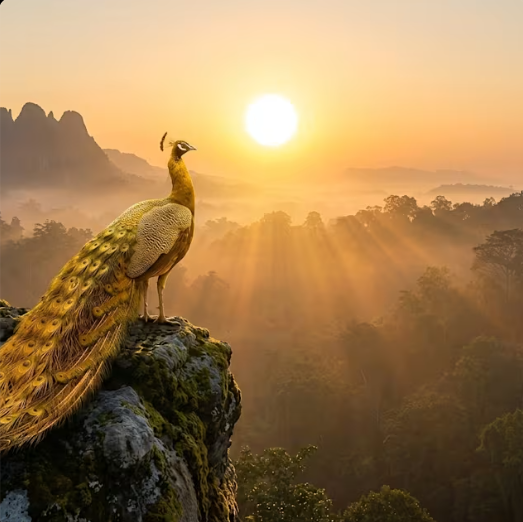
The golden peacock sees the sunrise every morning. That is when he recites his paritta. It is a kind of protective chant that is supposed to keep his day safe.
१७.उदेतयं चक्खुमा एकराजा, हरिस्सवण्णो पथविप्पभासो [पठविप्पभासो (सी. स्या. पी.)];
तं तं नमस्सामि हरिस्सवण्णं पथविप्पभासं, तयाज्ज गुत्ता विहरेमु दिवसं.
ये ब्राह्मणा वेदगू सब्बधम्मे, ते मे नमो ते च मं पालयन्तु;
नमत्थु बुद्धानं [बुद्धान (?)] नमत्थु बोधिया, नमो विमुत्तानं [विमुत्तान (?)] नमो विमुत्तिया;
इमं सो परित्तं कत्वा, मोरो चरति एसना.
Sanskrit Chaya
उदेत्ययं चक्षुमान् एकराजा, हरिवर्णः पृथिवीप्रभासः;
तं तं नमस्यामि हरिवर्णं पृथिवीप्रभासं, त्वयाद्य गुप्ता विहरेम दिवसम्।
ये ब्राह्मणा वेदगः सर्वधर्मे, ते मे नमो ते च मां पालयन्तु;
नमस्तु बुद्धेभ्यो नमस्तु बोधये, नमो विमुक्तेभ्यो नमो विमुक्तये;
इमं स परित्तं कृत्वा, मयूरश्चरति एषणायाम्।
English
This Clear-eyed One arises, the One King,
palomino-colored, shining over the earth.
I bow especially to you, palomino-colored, shining over the earth:
guarded by you let us live out this day.
Those brahmins who are knowledge-masters with respect to all things,
I worship them, may they keep me safe.
Hail the Awakened Ones, hail Awakening!
Homage to the freed ones, homage to freedom!
Having made this protection,
the peacock wanders seeking.
This prayer beautifully does two things first it accknowledges the Surya Deva as the Ruler of beings and also invoking worship of brahmins this is a older vedic layer , next it subtly shifts the homage to Buddhas , the awakened one this is a buddhist layer .
Ancient Parallels: From Conquest to Protection
The peacock morning prayer is not really out of the blue moon it incorporates Vedic Traditions of past. There are deep thematic links to Hindu epics and Vedic hymns that share these ideas
1) The Solar Baseline (Rigveda 1.50.1): The Vedic tradition views the sun as the "Clear-eyed One" because they believe it serves as the supreme all-seeing divine witness who monitors everything in existence.
उदु॒ त्यं जा॒तवे॑दसं दे॒वं व॑हन्ति के॒तव॑: । दृ॒शे विश्वा॑य॒ सूर्य॑म् ॥
2) The Āditya Hṛdayam (Vālmīki Rāmāyaṇa 6.105.15): In the epic Rāmāyaṇa, Lord Rāma recites a hymn to the sun right before his final battle with Rāvaṇa. While Rāma worships the sun for Vikrama (victory in battle and conquest), the Bodhisatta peacock subverts this epic goal. He uses a near-identical structure of solar adoration, but seeks Paritta (safety and peace).
The Aditya Hridayam, from the Valmiki Ramayana 6.105.15 says that in the Ramayana Bhagavaan Rama recites a hymn to the Surya Deva right before his final battle with Ravana. Bhagavaan Rama worships the Surya Deva for victory in battle while Bodhisattva peacock changes this near identical prayer structure to safety and peace .
नमः पूर्वाय गिरये पश्चिमायाद्रये नमः । ज्योतिर्गणानां पतये दिनाधिपतये नमः ॥
Welcoming the Night: The Evening Invocation
As the sun slips under the horizon, the peacock changes his chant. The way it’s put together stays identical but somehow the focus swings, surviving that vulnerability that comes with the dark.
Pali
अपेतयं चक्खुमा एकराजा, हरिस्सवण्णो पथविप्पभासो;
तं तं नम्मस्सामि हरिस्सवण्णं पथविप्पभासं, तयाज्ज गुत्ता विहरेमु रत्तिं.
ये ब्राह्मणा वेदगू सब्बधम्मे, ते मे नमो ते च मं पालयन्तु;
नमत्थु बुद्धानं नमत्थु बोधिया, नमो विमुत्तानं नमो विमुत्तिया;
इमं सो परित्तं कत्वा, मोरो वासमकप्पयीति.
Sanskrit Chaaya
अपेत्ययं चक्षुमान् एकराजा, हरिवर्णः पृथिवीप्रभासः;
तं तं नमस्यामि हरिवर्णं पृथिवीप्रभासं, त्वयाद्य गुप्ता विहरेम रात्रिम्।
ये ब्राह्मणा वेदगः सर्वधर्मे, ते मे नमो ते च मां पालयन्तु;
नमस्तु बुद्धेभ्यो नमस्तु बोधये, नमो विमुक्तेभ्यो नमो विमुक्तये;
इमं स परित्तं कृत्वा, मयूरः वासकल्पं अकरोत्।
English Translation
This Clear-eyed One sets, the One King,
palomino-colored, shining over the earth.
I bow especially to you, palomino-colored, shining over the earth:
guarded by you let us live out this night.
Those brahmins who are knowledge-masters with respect to all things,
I worship them, may they keep me safe.
Hail the Awakened Ones, hail Awakening!
Homage to the freed ones, homage to freedom!
Having made this protection,
the peacock made his home.
The Sun as the Guardian of the Spheres
The Mahabharata (Vana Parva 3.53) shows why this particular evening prayer stands as essential. Yudhishthira prays to the Sun in the Forest Book by saying that the world would become blind if the sun failed to rise.
The sun's daily cycle serves as the fundamental life support system which both Yudhishthira and the golden peacock understand. The peacock worships the setting sun to obtain the remaining defensive light which helps him navigate through nighttime darkness.
तव यद्युदयो न स्यादन्धं जगदिदं भवेत् ।
Echoes of Indra: The Linguistic Clues
The Pali text of the Mora Jataka uses Vocabulary which bridges the gap between Buddhist story-telling to older Vedic Mantra
-
Harissa (Palomino-colored): In the Pali text, the sun is called harissavaṇṇo. That comes from the Vedic term haryaśva, meaning “he of the yellow horses.” In the Rig Veda, for example 3.30.12–13, this kind of epithet shows up a lot as a label for Indra, the king of the gods, and Indra is closely linked with the sun and dawn.
दिश॒: सूर्यो॒ न मि॑नाति॒ प्रदि॑ष्टा दि॒वेदि॑वे॒ हर्य॑श्वप्रसूताः । सं यदान॒ळध्व॑न॒ आदिदश्वै॑र्वि॒मोच॑नं कृणुते॒ तत्त्व॑स्य ॥
दिदृ॑क्षन्त उ॒षसो॒ याम॑न्न॒क्तोर्वि॒वस्व॑त्या॒ महि॑ चि॒त्रमनी॑कम् । विश्वे॑ जानन्ति महि॒ना यदागा॒दिन्द्र॑स्य॒ कर्म॒ सुकृ॑ता पु॒रूणि॑ ॥ -
Ekaraja (The One King): While this word is used to talk about human rulers in other Jataka stories, but it is also used as a direct title for Indra in the Rig Veda (8.37.3).
ए॒क॒राळ॒स्य भुव॑नस्य राजसि शचीपत॒ इन्द्र॒ विश्वा॑भिरू॒तिभि॑: । माध्यं॑दिनस्य॒ सव॑नस्य वृत्रहन्ननेद्य॒ पिबा॒ सोम॑स्य वज्रिवः ॥
By applying these specific, ancient titles to the sun, the Mora Jātaka elevates the solar disc to a sovereign, almost divine status, while ultimately subordinating that worldly power to the higher spiritual goal of Vimutti (freedom/liberation) found in the Buddha's awakening.
Conclusion
The Mora Jataka is more than a simple fable about a bird, it feels like something deeper that people kept returning to. It is a fascinating literary artifact, kind of a window, because it shows how early Buddhists took the forceful resonant language tied to Vedic solar worship and repurposed it.
And that golden peacock, he is not really asking the sun for dominance, or calling for the destruction of foes , rather he mixing the old solar reverence with an homage to the “freed ones,” so the whole thing takes an ancient hymn of power and turns it into a timeless meditation on safety, gratitude, and spiritual liberation.

Sachit Varshney
120Advaita Vedantin with a passion for non-dual philosophy, exploring Hindu thought beyond Hindutva, orthodoxy, reformism, or Ambedkarite frameworks. Enthusiast of Sikh and Buddhist texts, weaving insights across traditions with curiosity and depth.


Comments & Discussion 2