Power of Truth and Surrender: A Dharmic Look at "Wingless Bird"
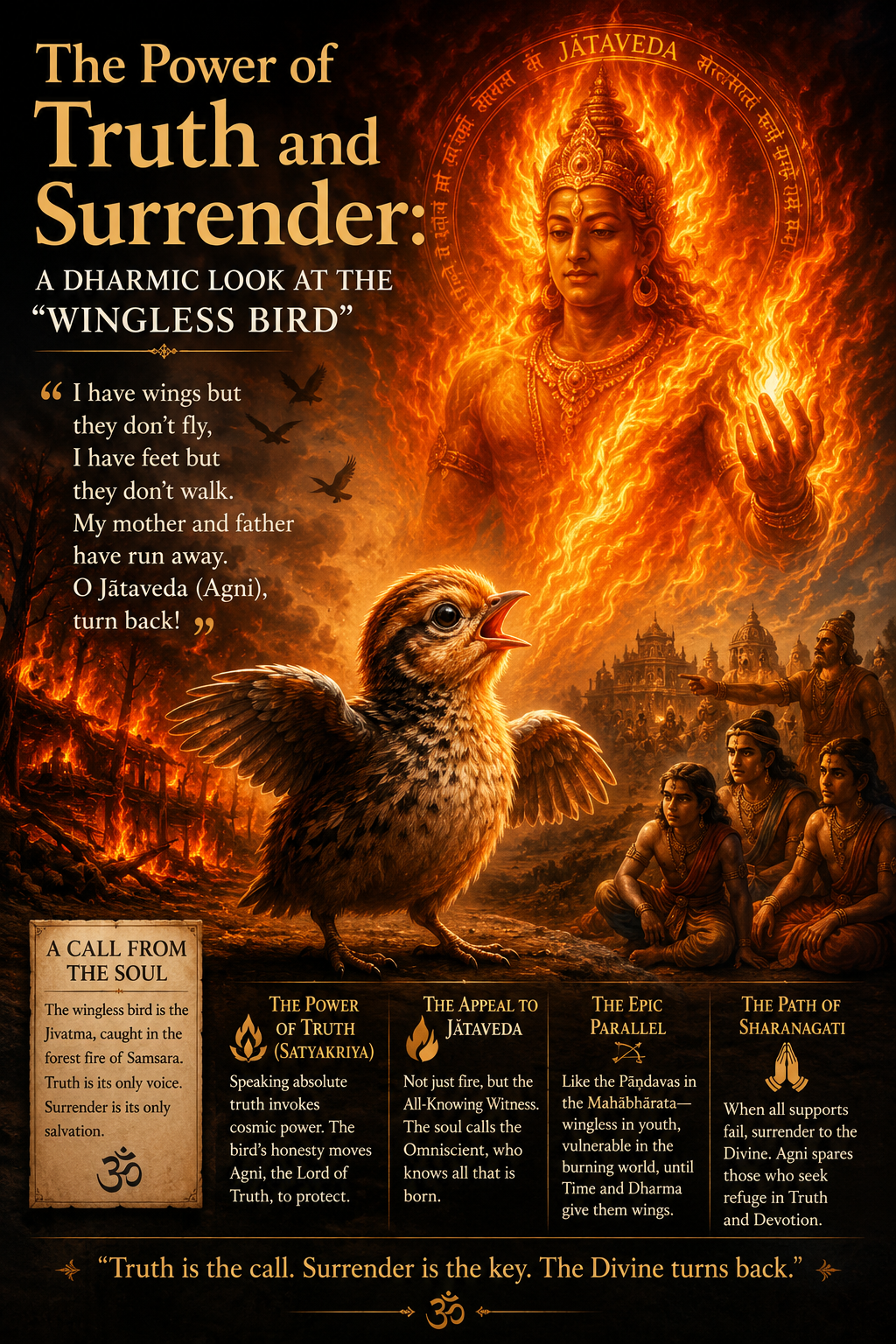
Ancient Indian wisdom says that nature is not an environment, but a great testimony to the experience of the Jiva (the individual soul). The Vaṭṭaka...
Ancient Indian wisdom says that nature is not an environment, but a great testimony to the experience of the Jiva (the individual soul). The Vaṭṭaka Jātaka is popular and the words, metaphors and theological concepts of it are highly Vedic and Puranic.
The Hindu philosophical interpretation of this verse brings up a great story of the Vedic God Agni (Fire), the power of Satya (Truth) and the practice of Sharanagati (Absolute Surrender).
The Invocation of Omniscient Fire is a Verse poem.
We have to go back to the verse, make sure you pay attention to the distinctly Vedic vocabulary:
Pali Mula:
३५.सन्ति पक्खा अपतना, सन्ति पादा अवञ्चना;
मातापिता च निक्खन्ता, जातवेद पटिक्कमाति.
Sanskrit Chaya:
सन्ति पक्षाः अपतनाः, सन्ति पादाः अवञ्चनाः ।
मातापिता च निष्क्रान्तौ, जातवेदः प्रतिक्काम ॥
English Translation:
I have wings but they don't fly, I have feet but they don't walk.
My mother and father have run away. O Jātaveda (Agni), turn back!
As a Hindu, this isn't a bird that is singing at a fire, it is a call from the spirit.
-
The Appeal to Jātaveda: The bird does not speak to the fire like a force of nature, but as one of the oldest and holiest of Vedic names, Jātaveda, for Agni. Jātaveda means the "one who knows everything which is born," or the "all-knowing one. The bird is asking the Divine Witness by this name. It's really saying, "You are the All-Knowing; I see my utter helplessness.
-
The Act of Truth (Satyakriya): In Dharmic traditions, when one claims to have an undeniable absolute Truth, then that is a cosmic power. The bird does not weep or curse his fate. It says three true things: my wings may not fly, my feet may not walk, my protectors are gone. Agni is the God of purity and truth and speaking the absolute truth brings the destructive and burning part of the Agni back to reveal its protective part.
The Mahābhārata Parallel: Vulnerability and Destiny
A very common motif in Hindu epics is that of the helpless newly hatched bird . This very metaphor is used in the Mahābhārata (Ādiparvan 1.194.3-4) for the Pāṇḍavas.
इहैव वर्तमानास्ते समीपे तव पार्थिव ।
अजातपक्षाः शिशवः शकिता नैव बाधितुम् ॥ ३ ॥
जातपक्षा विदेशस्था विवृद्धाः सर्वशोऽद्य ते ।
नोपायसाध्याः कौन्तेया ममैषा मतिरच्युत ॥ ४ ॥
Here, the text contrasts the state of being अजातपक्षाः शिशवः (ajātapaksāḥ śiśavaḥ - wingless infants) with being जातपक्षा (jātapakṣā - fully fledged).
-
The Material World as the Forest Fire: In their youth, the Pāṇḍavas lacked political power, alliances, and maturity. Therefore, they were highly vulnerable to the fiery schemes and deceitful ambitions of the Kauravas, such as the burning of the Lakshagriha (the wax palace).
-
Karma and Kala (Time): A soul must go through a karmic situation until it has the wings to fly. After undergoing tapas (penance) and forming pacts and following the principles of Dharma, the Pāṇḍavas developed their "wings" and became invincible. It is a political warning but deeper still, it is a Hindu concept of the temporary nature of vulnerability and of its being confined by Time.
In the Mahābhārata, the physical event is almost identical: During the Khandava-Dahana Parva, the children of the sage Mandapala are born as birds of the Śārṅgaka species, and are caught, trapped in a burning forest. They sing hymns to Agni, acknowledging that they have no power and Agni passes by them and leaves them in peace, thus showing that Agni protects those who seek His refuge).
The Spiritual Takeaway
As understood from the perspective of Sanatana Dharma, the baby quail represents the Jivatma (individual soul) engulfed in the flames of the forest fire called Samsara (the cycle of worldly sufferings).
The parents running away is the ultimate example of the fact that any worldly attachments, even the most sacred, cannot save us from cosmic realities.After the biological and material defenses ("wings that cannot fly"), the only option is Sharanagati – surrender to the Supreme. The soul will not be consumed by facing the fire in a steadfast manner, but rather it will ask the fire to move back and it will get spiritual salvation from God.

Sachit Varshney
120Advaita Vedantin with a passion for non-dual philosophy, exploring Hindu thought beyond Hindutva, orthodoxy, reformism, or Ambedkarite frameworks. Enthusiast of Sikh and Buddhist texts, weaving insights across traditions with curiosity and depth.

Comments & Discussion 0