What is Hindu Traditionalism?
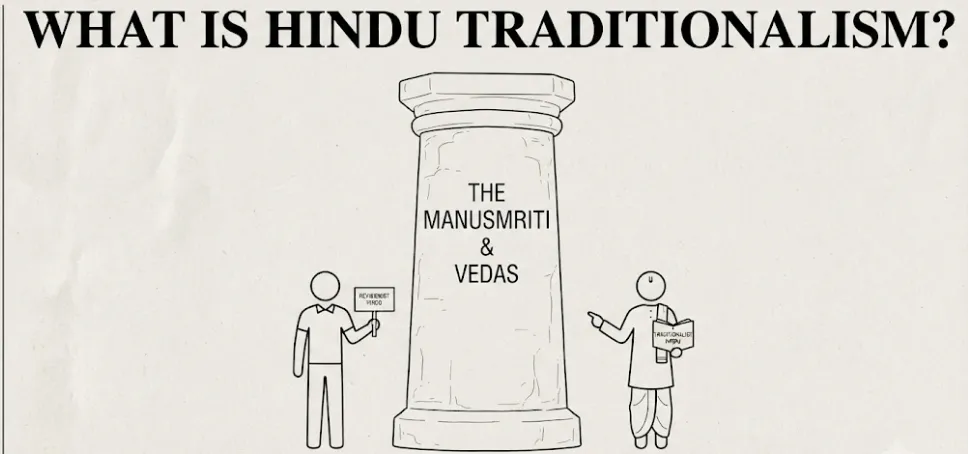
If you're active on social media or follow the news in recent times, you're well aware of Hindu trad movements. While the left marks Hindu traditional...
If you're active on social media or follow the news in recent times, you're well aware of Hindu trad movements. While the left marks Hindu traditionalism as their highest enemy, the so-called right wing isn't behind in criticizing them on social media either. But who are Hindu traditionalists?
A sect like Shiva? Shakta? Who founded this sect? When did it start?
The answer isn't that simple, but in layman's terms, anyone who agrees that the Manusmriti is the highest authority after the Vedas — as Shree Ram Chandra affirmed in Valmiki's Ramayana — can be considered a trad. Across Hindu sects, whether Shiva, Shakta, or Vaishnav, the Manusmriti holds authority after the Shrutis, for example:
"The Smritis (law-books/texts of tradition) emerged only after grasping the true meaning of the Shrutis (the Vedas). Therefore, the authority of the Smritis, such as those authored by Manu and others, is universally accepted."
Śrīmad Devi Bhāgavatam, Book 7, Chapter 39
How will you understand if he is a trad, very easily? Ask his view on the Varna system. If he says the Varna system is by birth, then he is obviously a trad.
Now, the question is: from when did this distinction come into force? Precisely when the British came to India! People like Ram Mohan Roy were the early internet-raita revisionists who started the trend of examining Hindu traditional practices through the lens of blank-slate morality. Several organizations like Brahmo Samaj, Young Bengal, and Arya Samaj originated — interestingly, Brahmo and Arya Samaj claimed to be taking Hindu society back to the Vedic system (as if prominent Sanskrit scholars like Madhusudan Saraswati and Raghunandan Bhattacharya hadn't read the Vedas). Whatever the case, these early organizations — except Young Bengal, which was utterly destroyed by trad leader Radhakanta Dev — used to accept the Manusmriti as authority. Even the so-called modern left-feminist icon Ram Mohan Roy, in his essay "Brahmanishtha Grihasther Lakshan" (1826 CE), stated that "every householder ought to follow the Manusmriti," even while attacking Bigraha Puja, which was the base of Hinduism at that time.
However, while Ram Mohan Roy selectively cited the Manusmriti as an authority, he completely rejected its explicit injunctions regarding Vigraha Puja (idol worship), which the Manusmriti(4.130) and foundational Hindu texts clearly prescribe. To this day, this remains a defining feature of revisionist Hindus: they cherry-pick Hindu texts exclusively according to their own subjective understanding and imported ideological morality.
Due to their closeness with the British government, these people were publishing their magazine and spreading it repeatedly among the elite youth of Kolkata. At that critical moment, a man rose as Samaj Pati of the Hindus whom even the British government feared — Raja Radhakanta Dev. With immediate effect, he established the Dharma Sabha; it was the first reaction from traditionalists. Derozio was removed from Hindu College with immediate effect; by order of Radhakanta Dev, no one gave him shelter.
The most famous encounters between traditionalist and revisionist Hindus were two cases: the Sati Pratha and widow remarriage.
Yes, trad Hindu society of Bengal supported Sati Pratha. But what was Sati Pratha at that time? According to Chinese travel accounts and the Astabinsati Tattva of Shree Raghunandan Bhattacharya — considered the law-book of Bengal, based on Smritis and Puranas, written around the 16th century — Sati is not mentioned as a prominent ritual; rather, celibacy of widows was promoted.
The rise of Sati probably happened during the rule of Siraj, as mentioned in several texts, including the famous case of Siraj trying to abduct the widowed daughter of Rani Bhavani. Unprotected women of Hindu households would choose to die with their husbands to preserve their own honor (obviously, modern-day OnlyFans feminists and their camera-holding modern brothers can't comprehend this kind of honor and value). In the British era, British cantonment soldiers used to target Hindu widows — that's why the Hindu-ruled Medinipur district had rarer cases of Sati than Kolkata, though it wasn't a widespread practice.
Yes, you're correct that Hindu Shastras do mention rituals like Sati, but it's not like the leftist popular-culture depiction of evil Brahmins dragging a widow with heavy sound to burn her alive — not that. It was, historically, a voluntary practice, and one associated with Kshatriya women; early Greek(Aristobulus of Cassandreia)sources also mention Sati, so it's neither an Islamic-era addition to Hindu scripture.
"The Hindus as a race do not eat beef and their men and women do not eat and drink in the same place. When the husband dies the wife does not marry and when the wife dies the husband does not marry. The orphans and widows who have none to support are fed by the houses of the village by turns and are not allowed to go to other villages to beg for food."
15th Century Chinese Royal records.
Visva-bharati Annals vol 1
Now, what was the trads' point, and how was it resolved? Ram Mohan Roy, contrary to popular culture's depiction of him as some force fighting the Brahmins, took the Manusmriti and showed that it doesn't mention Sati — that Manu said it's better to maintain celibacy. [Interestingly, in his own English writing, Ram Mohan marked Sati as suicide.]
But the trad side maintained its own position: why should the British government interfere in Hindu social customs when we have our own authority? It was a legitimate stand, and it marked the start of the state controlling Hindu rituals, customs, and temples. Radhakanta Dev used full force to stop British interference, but alas, the British Empire was much more powerful. Though Sati wasn't such a widespread practice as to have much effect, when the British legalized widow remarriage, the trads took another step that completely shocked the British state: the "Ekghore rule." This meant that if you married a widow, you would be kicked out of the village — no one would sell you vegetables, no one would associate with you, complete isolation. That worked marvelously; the message reached every village in Bengal. Mandirs became small control centers, and trads successfully stopped widow remarriage in the villages. Though some elites did it symbolically, it didn't sustain.
In later pieces, I will describe the reaction to this from the British and revisionist forces — not in this piece. But that's how it started. Otherwise, before that, all Hindus were trads — basically, revisionists are the illegitimate children of the trad system, affected by blank-slate morality, ashamed to accept their own ancestors.
Now, what is blank-slate morality, which is basically the pillar of modern morality? The popularity of the blank slate, or tabula rasa, is basically attributed to John Locke, though many trace its sources to Aristotle. Whatever the case, the basic idea is that all humans are born blank, and all you acquire is through your surroundings. Here it must be noted that this is the exact philosophy underlying many modern ideologies, and most interestingly, it underlies revisionist Hinduism, Marxism, capitalism, libertarianism, and Christianity — Thomas Aquinas included it in Christianity, though the idea of being equal before God was native to Christianity.
Now, as per this ideology, all that matters for a child's upbringing is the nature of their surroundings — not lineage, not parents. It's the basis of the doctrine of equality: since everyone is born blank, we're all the same. Then the natural question arises: why does hierarchy exist? Why do we see natural hierarchy — yes, in the nature they're brought up in (though the religious blank-slate proponents don't explain why their God didn't create equal natures for all)?
In layman's terms, imagine an isolated island where you take 100 boys at age zero and give them the same food, clothes, books, and teachers. As per blank-slate theory, all 100 boys would score the same marks, and their performance would be similar. Now, the champions of blank-slate theory — the Marxists — in their passion to prove the blank slate, carried out a massacre of scientists and marked genetics as a pseudoscience, as literature confirms.
"Although the idea of a beginning to the universe might not be very welcome to communist ideas, ideology was never allowed to stand in the way of science in physics. Physics was needed for the bomb, and it was important that it worked. However, Soviet ideology did prevent progress in biology by denying the truth of genetics."
— Brief Answers to the Big Questions, S. Hawking
They killed genius scientists like Nikolai Vavilov, and many others, just because genetics was proving the uniqueness of each life, which was a potential threat to the blank slate. They killed many physicists too, as Hawking noted.
A thought experiment for readers: what would have happened if both the USA and USSR were communist? Would we ever have been able to know the truth of genetics, and the creation of the Big Bang from a materialist perspective?
Now, how can we define traditionalism in general?
Who are trads? A very basic idea:
1. Believe in specific gender roles.
2. Believe in modesty and certain unquestionable rules in society.
3. Respect hierarchy.
4. Must have a family and successors.
5. Idea of a holy land, loyalty toward the tribe.
These are the bases of traditionalism.
Now, do traditionalists oppose technological advancement?
》No.
》Bhautika Vigyana isn't static; it can be changed and updated, as trads themselves have done in the past.
Traditionalism is mainly a social structure organized around rigid morality. This will be very clear from Manusmriti 12.108–110:
"If the question should arise — 'How should it be in regard to those points upon which the laws have not been declared?' — [the answer is] what the cultured Brāhmaṇas declare, that shall be the undoubted law. Those Brāhmaṇas by whom the Veda, along with its supplements, has been learnt in the right manner, and who are guided directly by the revealed texts, shall be regarded as 'cultured.'"
Basically, Maharaj Manu well established the fact that material knowledge will see changes, so questions of Dharma and Adharma may arise. Take a modern case: the use of smartphones — how did Hindu trads perceive it? (The progressive communists banned cybernetics.)
Trad Hindus neither opposed smartphones nor airplanes, but in trad circles, specific uses of smartphones — like watching pornography or images of naked women — are banned. That's what traditionalism is: a rigid moral stand. That's why the duty is eternal.
Here again, it should be mentioned that Maharaj Manu never opposed any kind of modern science — that's why, in practice, you don't see Hindus burning or killing scientists for their discoveries.
Saptarshi Pahari
280M.Sc. Physics student focused on Electronics | Independent researcher in structural philosophy & traditional history | Essayist & author of The Anatomy of Social Friction. Saptarshi Pahari is a traditionalist writer and analyst dedicated to the defense of orthodox Hindu theology
Comments & Discussion 0