A Summary of the Indian Reservation System
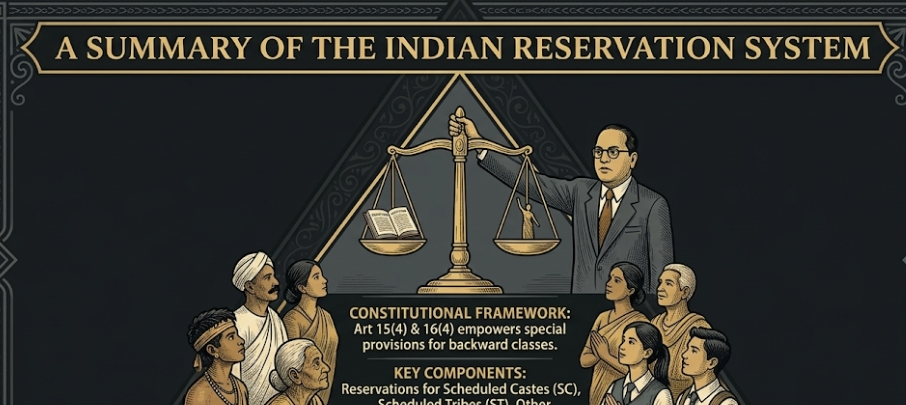
Reservation is the most heated topic among Gen Z on social media. Although it has been a long-standing issue in Indian politics, it has gained a stron...
Reservation is the most heated topic among Gen Z on social media. Although it has been a long-standing issue in Indian politics, it has gained a stronger narrative over the last ten years. Gen Z is divided into two factions: one supporting and trying to expand it, and the other trying to abolish it. Today, we aim to address this debate: should reservation exist or not?
According to its supporters, reservation was introduced to uplift the oppressed sections of society and bring equality. Why reservation?
Supporters argue that the Manusmriti denied education to Shudras and created a system like Dronacharya's, designed to deny capable positions to individuals like Ekalavya. As a result, this oppressed class was unable to attain top or respectable positions. Furthermore, upper castes were majorly landholding communities that denied the oppressed class financial wealth, keeping them impoverished. Thus, reservation exists to ensure that today's Ekalavya gets the seat they deserve.
Reservation is not a poverty alleviation scheme.
Now, where did reservation originate? Ironically, the criticized Manusmriti was first book to introduce an early form of reservation, though its system was entirely different. It granted specific groups 100% reservation in particular professions.
What would Manusmriti-style reservation look like in the modern day?
People of the Suta community would hold 100% reservation for railway loco pilot positions.
People of the Shudra communities would have 100% reservation for railway technician posts.
Brahmins would have 100% reservation in teaching (at least for Sanskrit and Vedic subjects).
Furthermore, the Manusmriti stated that each community was prohibited from performing the work of another unless it was an Aapad Kaal (emergency/crisis) situation. Under normal conditions, Brahmins and Shudras were forbidden from doing each other's jobs.
This was even noted by Megasthenes in Indica:
"It is not permitted for anyone to marry into another caste, or to change from one profession or trade to another; for example, a soldier cannot become a farmer, nor can an artisan become a philosopher."
So basically, each caste held 100% reservation theoretically and, in most cases, practically in specific jobs.
Now back to modern reservation in India: it grants specific groups of people a reserved proportion of seats across all fields.
General category individuals who oppose the reservation policy present these points:
If the state is secular and treats everyone equally, how can caste-based reservation exist?
It is an injustice to merit.
Reservation should be based on economic condition, not caste.
Now let us observe the arguments from both sides. Supporters of reservation say the Manusmriti denied education to lower castes. However, the first question that arises is: was the Manusmriti applied practically across all Hindu states?
For how long was it actually enforced? Around 250 BCE, Buddhist rule was established in India under Ashoka the Great, and later, regions extending from Kashmir to Bengal saw Buddhist rulers. Did they also follow the Manusmriti? Furthermore, after the 1300s, Muslim dynasties ruled large parts of India—did they follow the Manusmriti?
If caste-occupation persisted for centuries under non-Hindu, non-Manusmriti-enforcing rulers, then caste stratification can't be purely a Manusmriti-imposed system — it points to a socioeconomic/guild-based inertia independent of any single legal text.
If the caste system strictly denied education and agency, why did the flag-bearers of social equality—such as Buddhism and Islam—fail to eradicate caste identity among converts? Even after converting, why did people remain tied to their traditional, caste-identified occupations? Even today, for instance, certain Patachitrakars (traditional scroll painters) of Bengal converted to Islam, yet they continue to practice their hereditary caste-based craft.
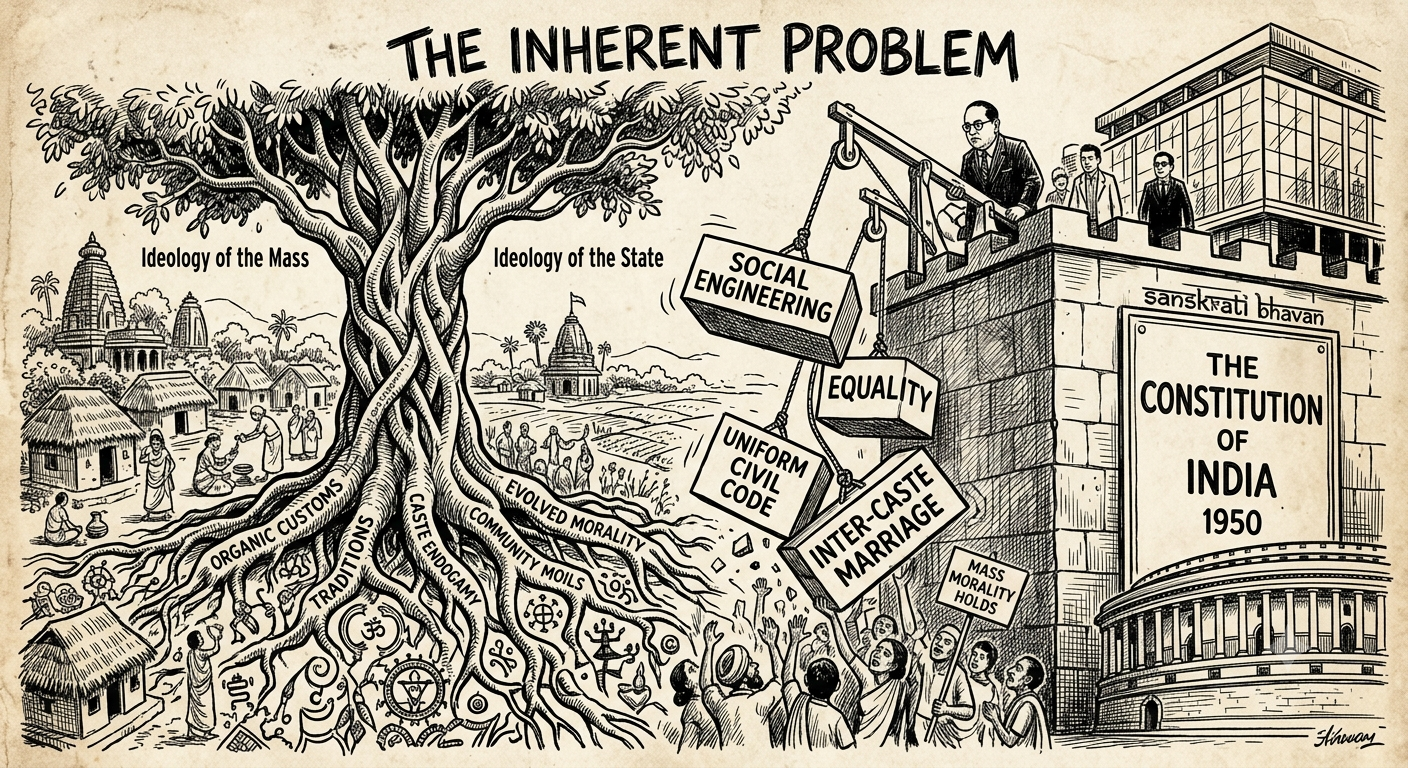
Caste persisted because reality is very different from ideological utopia. The egalitarian, anti-caste ideology of Charvaka failed to build even a village-level economic civilization. People live by money and food, not ideology. The caste system was so sufficient in practical life that British officials described it as a "village republic" — each village a self-sustaining unit. Every Hindu religious festival was structured so that each caste earned money from it: take Durga Puja, where money flows from the Brahmin to the potter (kumar) to the flower-sellers, sustaining the whole chain. Charvaka failed to provide the basic human needs of food and economic stability to its followers — ideological fairy tales don't fill an empty stomach. Manu did, even if his ideology sounded harsh. The Buddha did the same thing in reverse: he preached an anti-caste, egalitarian ideology early on, but the moment it became a state religion, it realized that without caste, society would slide into chaos — where skill, trade, and marriage still ran on hereditary, guild-based lines, because that was the only functional model an information-scarce world had. The tide came in. By the Mahayana era, the retreat was doctrinal, not just social: even the birth of a Buddha was restricted to the Kshatriya or Brahmin varna. The ideology hadn't been defeated by argument — it had simply been unable to survive contact with the economic logic it was built on. Egalitarianism was the sandcastle of the Buddha, destroyed by the first wave of economic reality of the ancient era.
This reveals a reality that people often overlook by confusing modern career choices with the pre-printing press era. Today, switching careers—for example, moving from mechanical engineering to software engineering—is a matter of a few years. But even in the 1700s, changing professions was not that simple. Books were scarce and knowledge transmission was restricted.
Even among Brahmins, specialization was localized and hereditary; for example, the Brahmins of Nabadwip in Bengal were famous specifically for Navya-Nyaya (logic). Similarly, the artisan communities of Bengal were renowned for specialized crafts like weaving sarees, pottery, and painting. All knowledge systems were naturally hereditary. Setting the Manusmriti aside, even Shudra communities subdivided themselves into functional guilds for ease of trade and skill preservation, such as Tanti (weavers), Kumbhakar/Kumar (potters), and Karmakar/Kamar (blacksmiths).
Theoretically, they are correct that the Manusmriti served as an ideal Hindu text and held high authority—so much so that it is often cited as the constitution of Ram Rajya.
Now, is it a fact that the Manusmriti denied education to Shudras? The answer depends on what kind of education is meant. Manusmriti 10.99–100 clearly states that Shudras had exclusive rights over engineering, arts, crafts, and related domains. Illiterate people could not have constructed such marvelous temples. While the Manusmriti denied Shudras the education of the Vedas, study of the Puranas and Itihasa was permitted. It was mostly a mutual structure where Brahmins were also prohibited from practicing the crafts of Shudras. Therefore, theoretically, Shudras were never entirely denied education.
Regarding the second point—that upper castes were mostly landholding communities—this is a generalization. In Bengal, for instance, communities like the Bhumij and Santal held significant land and revolted against British rule. Similarly, the Kaibarta community revolted against the Buddhist Pala kings over land rights. The landscape shifted significantly under British rule.
Ironically, the supporters' point that reservation is not a poverty alleviation scheme contradicts the landholder argument. If money does not shape innate intelligence—which is largely an inherited biological property of humans—access and exposure come with financial means. If that is the primary premise of reservation, it is ultimately tied to economic conditions. If most lower-caste individuals are poor, they should logically benefit from an economically based reservation framework.
However, a valid concern arises regarding the "Ekalavya effect" (setting aside the specific nuances of the Mahabharata narrative): during interviews, upper-caste panelists might favor people from their own group (ingroup/tribe bias) and exclude capable lower-caste candidates. This is a legitimate concern and a documented phenomenon worldwide based on caste, tribe, university, language, and background. People often prefer candidates from their own village, district, religion, or ideology, even over those with higher merit.
So, what is the solution?
Here is a proposed approach:
Completely free education: Eliminate tuition costs for all public universities and colleges.
Reservation for first-generation learners: Grant reservation to the first individual in a family to pursue higher education (irrespective of caste). If a parent holds a 10th-grade qualification or higher, the applicant would not be eligible.
Reservation for the economically weaker class: Restrict financial reservation to families earning below a specific threshold (e.g.500,000/year).
Abolition of interviews and recommendations in government recruitment: Rely entirely on standardized written examinations to eliminate subjective bias and neutralize the "Ekalavya effect.”

Saptarshi Pahari
280M.Sc. Physics student focused on Electronics | Independent researcher in structural philosophy & traditional history | Essayist & author of The Anatomy of Social Friction. Saptarshi Pahari is a traditionalist writer and analyst dedicated to the defense of orthodox Hindu theology


Comments & Discussion 0