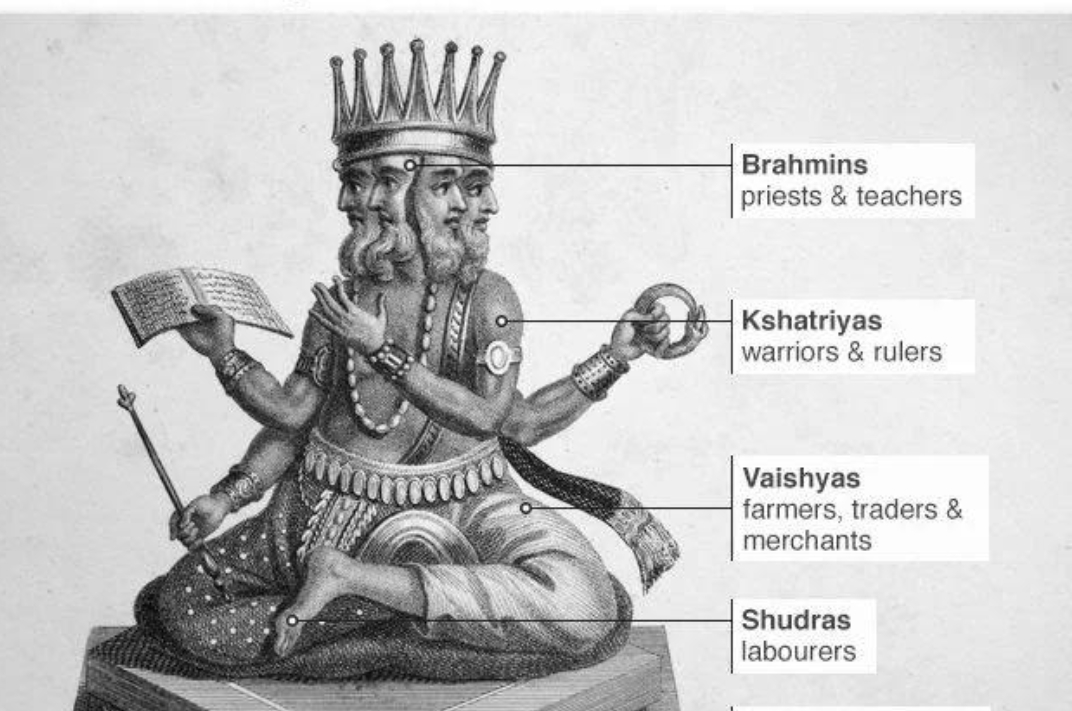
Caste system harmed Hinduism?
HinduText AI से इस लेख का सारांश समझें
लेख के मुख्य आध्यात्मिक संदेश एवं सारांश पर AI से चर्चा करें
In online discourse and among some prominent historians, it is often stated that Hinduism faces problems because of the birth-based caste system, whic...
The modern academic establishment and their online echo chambers love to repeat a singular, intellectually lazy dogma: that Hinduism’s historical challenges are the fault of a rigid, birth-based Varna-Jati system, and that this supposedly oppressive hierarchy drove the masses into the arms of egalitarian invaders. This is not historical analysis; it is a weaponized narrative designed to level our civilization. As a defender of the foundational order, I demand answers to the glaring anomalies these secular historians consistently sprint away from.
● If this system was an intolerable prison, why did "casteless" Buddhism completely evaporate from the soil of its birth while the organic Hindu structure endured?
●Why did a mass, violent anti-caste rebellion never occur across millennia, even though these supposedly crushed subaltern classes routinely found the will and the arms to rebel against Buddhist and Islamic rulers?
The truth is that conversions during the Islamic and European eras were driven by the brutal realities of statecraft and shifting geopolitical power dynamics, not lower-class flight.
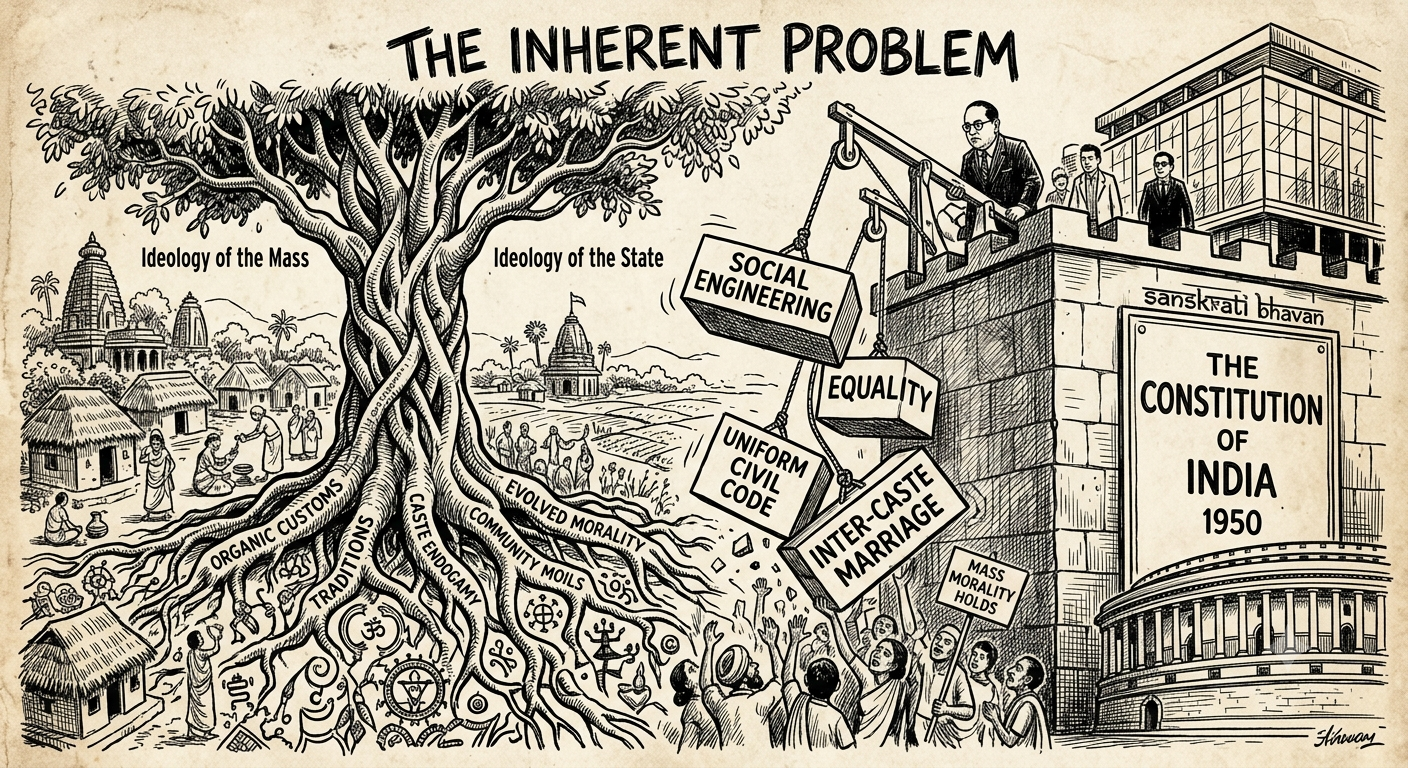
Caste was never the weakness; it was the decentralized, unbreakable fortress that saved Hinduism from total assimilation. It is the absolute, living nightmare of the modern doctrine of leveling equality, which is exactly why the Macaulay system sought to systematically eradicate it to leave the individual atomized and defenseless before the state.
To prop up their fragile thesis, these detractors cherry-pick random verses from the Manusmriti out of context, completely blind to the foundational laws of Sanskrit exegesis. They read alankara—rhetorical hyperbole and metaphor—as literal administrative law. Assertions that certain tiers lacked independent absolute rights are structurally identical to the text's claims that "the Brahmin owns the entire universe" or "the King is a visible deity." These are axiomatic statements of spiritual and sovereign primacy, not empirical property deeds—after all, the exact same text states that a son is a slave to his father, yet no one claims Manu banned sons from owning property.
When you strip away the hysteria and look at the actual administrative and economic protocols in the seventh, eighth, and tenth chapters, a highly sophisticated framework of material franchise and economic agency emerges. Manu explicitly commands that employers must calculate the compensation of creators and manual producers (Shudras) not just by raw market utility, but by taking into account the exact number of dependents they must sustain¹. Furthermore, if a primary Brahmin patron fails to provide, the text explicitly guarantees the producer the legal right to exit, seek employment under a wealthy Kshatriya or Vaishya, or launch an independent Shilpa—an artisanal, technical, or engineering enterprise². This guaranteed material franchise and economic mobility is precisely why a mass revolt never materialized; the system protected life and livelihood far better than any modern state.
The accusation of systemic discrimination regarding knowledge is equally hollow. Manusmriti makes it undeniable that the masses were never denied an education in the practical sciences, technologies, or arts³. The restriction applied strictly to the oral transmission of Vedic liturgy. In any logical, administrative context, the Brahmin class authored, preserved, and structurally maintained the Vedas across generations through rigorous, uncompensated discipline. They held the ultimate "Intellectual Property" over this metaphysical technology. If a specific corporate guild creates and flawlessly preserves a highly specialized body of knowledge, by what absurd logic is it labeled "discrimination" when they choose to restrict its access?
The frantic, desperate obsession of Marxist and progressive schools to dismantle this birth-based architecture is born out of strategic frustration, not humanitarian empathy. They recognize that their totalizing, leveling ideologies cannot conquer India as long as the population is insulated by organic, hereditary corporate units. Their own ideological father saw this structural reality with brutal clarity when he observed that:
Mohammedanism made more rapid progress among the Persians than among the Hindus because their priest class was lowest and most degraded class, whereas in India the Priest (Brahmins) was the most powerful political agent in the Commonwealth.
Karl Marx, Notes on Indian History p.8
Marx understood what his modern disciples try to erase: the Brahmin-led commonwealth was an insurmountable barrier to total ideological subversion because its authority was distributed throughout the decentralized social architecture, rather than resting in a brittle, centralized state neck that could be easily severed. The assault on our hereditary framework is an attempt to reduce a towering, stratified civilization into a fluid, defenseless mass of consumer-workers. Against this modern leveling madness stands the eternal, unalterable law of reality. As Friedrich Nietzsche fiercely articulated in The Anti-Christ:
The order of castes, the highest, the dominating law, is merely the ratification of an order of nature, of a natural law of the first rank, over which no arbitrary fiat, no 'modern idea,' can exert any influence. A high civilization is a pyramid: it can stand only upon a broad base; its primary prerequisite is a strongly and soundly consolidated mediocrity. To handicraft, to commerce, to agriculture, to science, to the greater part of art, in a word, to the whole complex of professional activity, an industry of ability is completely indispensable; it is compatible with neither a passion for a variety of occupations nor a lack of distinct aims... To be a public utility, a wheel, a gear, a specialized function, is a natural vocation: it is not society, but the kind of 'happiness' of which the majority are alone capable, that makes them intelligent machines. For the mediocre, mediocrity is a happiness; mastery in one thing, specialization, is a natural instinct.
Friedrich Nietzsche, The Anti-Christ, Section 57
1. Manusmriti 10.124
2.Manusmriti 10.121 , 99, 100 & 124
3.Manusmriti 10.99–100

Saptarshi Pahari
280M.Sc. Physics student focused on Electronics | Independent researcher in structural philosophy & traditional history | Essayist & author of The Anatomy of Social Friction. Saptarshi Pahari is a traditionalist writer and analyst dedicated to the defense of orthodox Hindu theology



Comments & Discussion 3