The Invention of the "Hindu" Identity
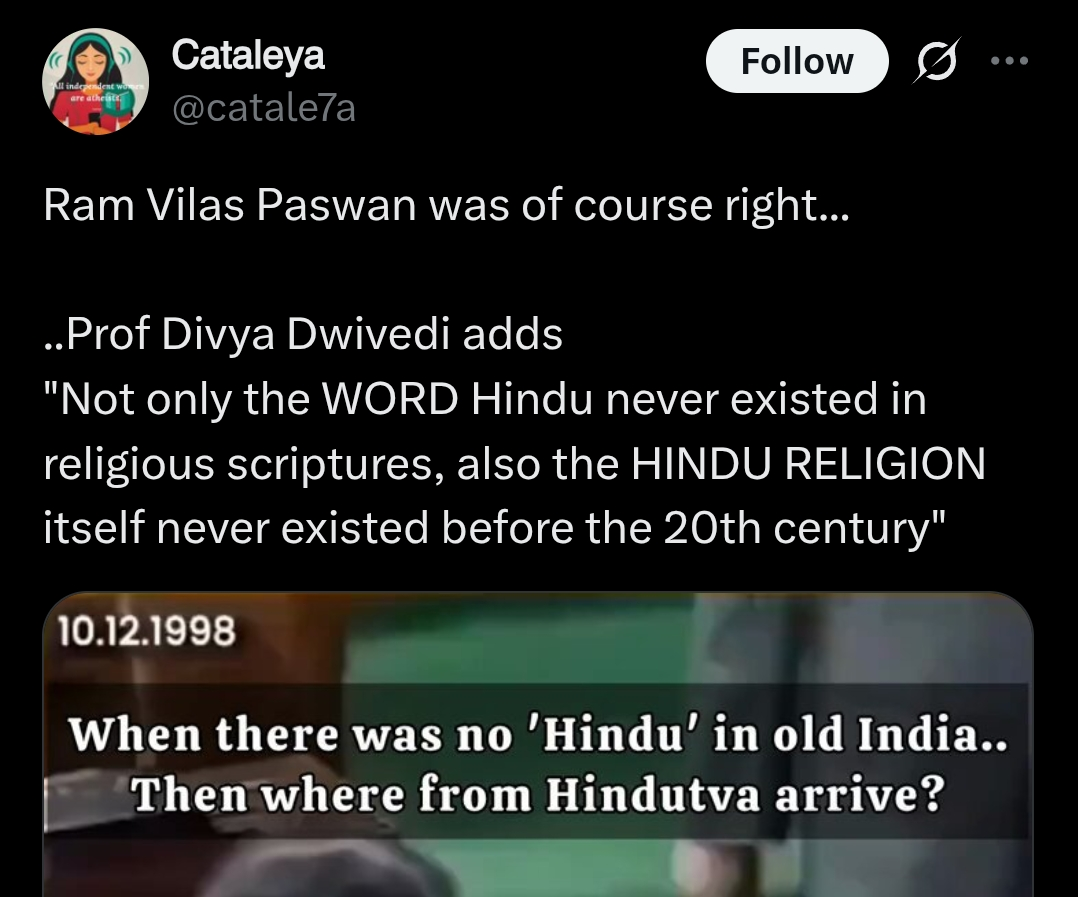
"A unified Hindu religious identity is a modern invention. Stretch it as far as you want — you cannot go beyond the 19th century."
The word Hindu as a religious identity predates the 19th century by centuries.
Chaitanya Charitāmṛta, Ādi Līlā, Chapter 17.193 uses the phrase:
"নগরে হিন্দু ধর্ম বাড়িল অপার। / হরি হরি ধ্বনি বই নাহি শুন আর"
("In the city, Hindu Dharma spread boundlessly — nothing was heard but the chanting of Hari.")
This is a 16th century Bengali text using Hindu Dharma as a lived religious identity — not an ethnic label, not a geographic marker. A religious civilisational identity.
And it wasn't just Hindus using this term. Syed Sultan — one of the most prominent medieval Muslim poets of Bengal — wrote:
"কিতাবের কথা দিলু হিন্দুয়ানি করি"
("I have rendered the words of the scripture in the Hindu way")
Here a Muslim poet uses Hinduyānī to mean Hindu culture, Hindu religious expression — Bengali language, Hari nām, the whole civilisational package. This is an external observer recognising a distinct religious-cultural identity centuries before the 19th century.
Analyze this myth with HinduText AI
Discuss authentic scripture references and context with AI
Detailed Investigation
Ancient and medieval India did not require a centralized, Vatican-style "church" to have a functional, unified identity. Instead, identity was anchored to the acceptance of the Vedas as the supreme cosmic authority. If a school or sect accepted the authority of the Vedas, it was classified as Āstika (orthodox); if it rejected them, it was Nāstika (heterodox). This foundational sorting mechanism shows that a sharp, cohesive boundary between what we today call the "Sanatana/Hindu" umbrella and outside philosophies was structurally alive thousands of years ago.
To assert that this identity was magically cooked up by 19th-century British bureaucrats completely ignores centuries of indigenous literature, epigraphic titles like Hindurāya Suratrāna ("Sultan among Hindu Kings") used by 14th-century Vijayanagara emperors, and the lived reality of millions of ancestors who guarded their Vedic heritage long before the first colonial ship ever docked in India.
Sources & References
Chaitanya Charitām ta, Ādi Līlā, Chapter 17.193.

Saptarshi Pahari
280M.Sc. Physics student focused on Electronics | Independent researcher in structural philosophy & traditional history | Essayist & author of The Anatomy of Social Friction. Saptarshi Pahari is a traditionalist writer and analyst dedicated to the defense of orthodox Hindu theology


Comments & Discussion 2